
Key Takeaways
-
Unlock hands-off crypto exposure with DeFi index funds: Individuals can automatically gain diversified portfolios through tokenized baskets, mirroring popular ETF models, and do so without the burden of constant monitoring or manual trading. This automation provides an accessible pathway to diversified crypto investing for both beginners and seasoned participants.
-
Automated rebalancing requires careful evaluation: Each index protocol uses its own smart contract logic to rebalance holdings, from straightforward periodic tweaks to complex, rules-based systems. These variations directly impact the level of risk and the potential returns. Understanding the specific automation and rules behind a protocol is crucial for selecting the right fit for your investment approach.
-
Smart contract risk is a critical consideration: The quality and security of underlying code varies significantly between protocols. Some commit to continuous audits and updates, while others may expose investors to bugs, exploits, or weak governance. Smart contract security is a core factor beyond just portfolio diversification. Due diligence cannot be overlooked.
-
Fee structures influence your real-world returns: DeFi index tokens typically layer protocol, transaction, and management fees. Total costs can add up over time. Careful assessment of these fees ensures your passive investment strategy remains cost-effective and that compounding costs don’t erode your potential gains.
-
More than just diversification. Gain efficient market access: Leading DeFi index protocols offer instant, cost-effective entry points into entire sectors, specific investment themes (such as DeFi blue chips or metaverse), and trending narratives. With a single token, investors can track broad markets or emerging fields that might otherwise require multiple transactions and continual oversight.
-
No two index tokens are identical: Differences in asset selection, weighting mechanisms, rebalancing schedules, and custody solutions mean every basket token has its own risk and return characteristics. Taking the time to research these key differences determines whether a particular index aligns with your investment goals and risk tolerance.
-
Comparison is essential before committing: Top index protocols, including Index Coop, PieDAO, and BasketDAO, each take distinctive approaches to liquidity, governance, transparency, and methodology. Comparing these differences, rather than simply chasing past performance, helps you select the best solution for your passive DeFi strategy.
With these essentials in mind, you’ll be prepared to evaluate DeFi index tokens and protocols based on what truly matters: not just diversification, but the underlying security, cost structures, and operational transparency. The next sections will explain how these funds work, break down the leading platforms, and share practical strategies for building a forward-thinking crypto portfolio.
Introduction
Diversification in crypto once meant managing dozens of tokens and keeping track of endless price charts, often with multiple browser tabs open. Today, DeFi index funds are redefining this process, enabling investors to participate in entire sectors with a single token that automates exposure and portfolio management. By simplifying access to broad crypto markets, these tokens eliminate the constant juggling of individual trades and complex rebalancing decisions.
For anyone seeking a smarter, less labor-intensive way to invest in DeFi, understanding tokenized index baskets is essential. Factors such as fee structures, rebalancing logic, and the reliability of smart contract security all play a major role in your overall risk and expected returns. By exploring the mechanisms behind top DeFi ETF protocols, you’ll learn how design choices can affect results, and what to watch for when choosing the right basket tokens for your long-term crypto goals.
Understanding DeFi Index Funds and Tokens
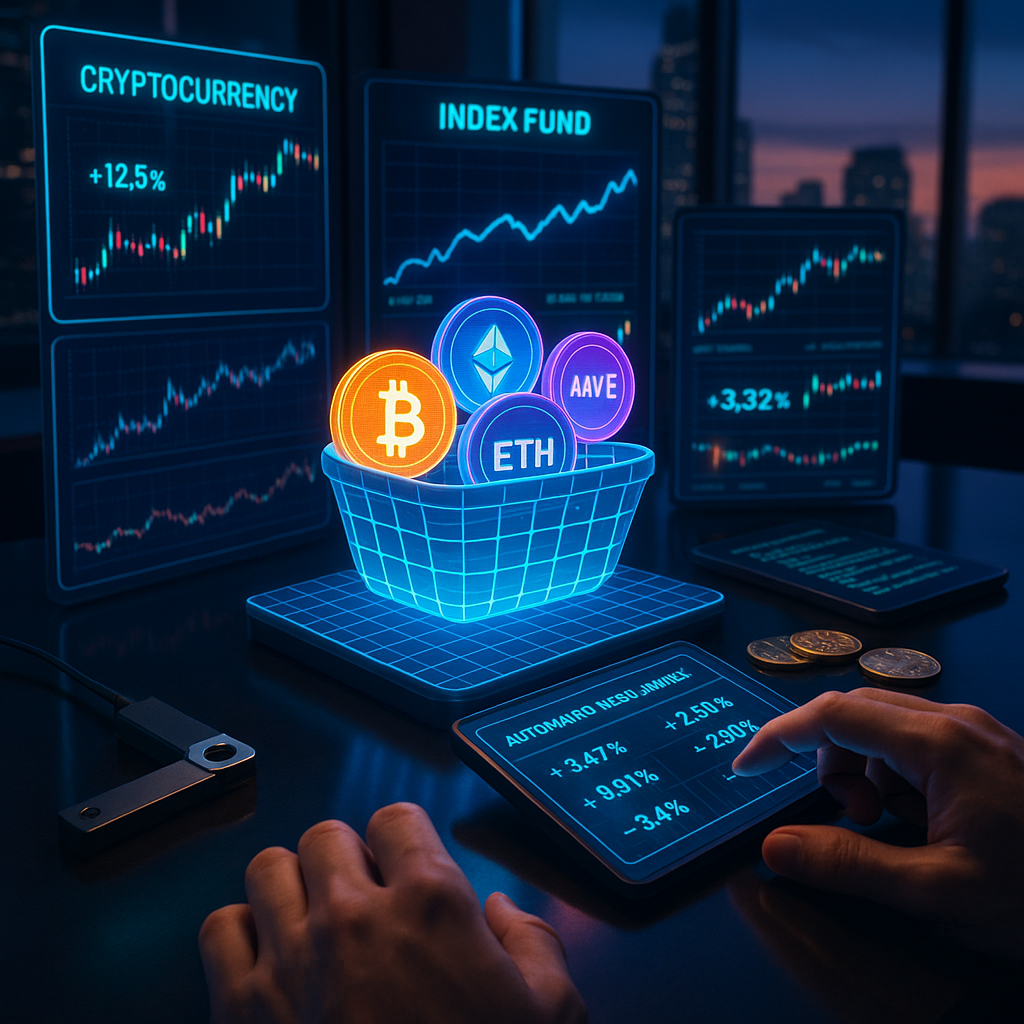
DeFi index funds mark a transformative step in crypto investing. They offer exposure to carefully selected baskets of digital assets, accessible through a single token, and governed entirely by smart contracts. Unlike the decades-old index funds in traditional finance, DeFi indices replace intermediaries with on-chain automation, unlocking decentralized and truly global investing opportunities.
Stay Sharp. Stay Ahead.
Join our Telegram Group for exclusive content, real insights,
engage with us and other members and get access to
insider updates, early news and top insights.
 Join the Group
Core Mechanics of DeFi Index Funds
DeFi index tokens operate as ERC-20 tokens, each representing proportional ownership of an underlying basket of assets. Their core mechanisms include:
- Token Issuance: When a user deposits funds, smart contracts automatically purchase all component assets in set proportions, then mint and deliver index tokens in return.
- Redemption Process: Holders can redeem index tokens at any time, exchanging them for the underlying assets. This entire process is handled by the protocol’s smart contracts, removing the need for intermediaries.
- Net Asset Value (NAV): The token’s value adjusts in real time, reflecting the combined real-time value of constituent assets, and typically maintains a close relationship to net asset value.
- Smart Contract Automation: Key functions (minting, burning, rebalancing) are transparently executed by code, often with parameters that can be updated by token-holder governance.
The main benefit is simplified portfolio management. Instead of tracking and manually rebalancing multiple holdings, investors can maintain broad exposure with a single asset that automatically adheres to a pre-set allocation.
Types of DeFi Index Funds
The DeFi index ecosystem has matured to include several fund types designed to accommodate a variety of investment strategies and objectives.
Sector-Specific Indices
These funds focus on designated segments of the crypto market:
- DeFi Indices: Track key projects within decentralized finance, such as lending, decentralized exchanges (DEXs), or derivatives protocols.
- Metaverse/NFT Indices: Provide bundled exposure to tokens associated with gaming, virtual reality, and digital collectibles.
- Layer-1 Indices: Aggregate major blockchain networks beyond Ethereum (like Solana, Avalanche, or Polkadot), offering a single-point entry into platform wars.
Such baskets allow investors to gain diversified exposure to fast-growing crypto themes without picking individual winners.
Strategy-Based Indices
Other funds implement specific investment strategies through automation:
- Yield-Generating Indices: Allocate assets across protocols that offer staking, lending, or farming, letting holders earn passive income on top of market exposure.
- Volatility-Optimized Indices: Adjust allocations dynamically to lower overall risk and smooth out returns during turbulent markets.
- Momentum-Based or Trend-Following Indices: Increase weighting toward assets exhibiting strong upward price momentum.
Beyond DeFi, similar strategies are making inroads in industries such as finance (automated ETF rebalancing), healthcare (allocating research grants to trending drug developments), and legal tech (bundled litigation-related tokens).
Weighting Methodologies
Index construction varies widely in how components are weighted:
- Capitalization-Weighted: Allocates according to each asset’s market value, so larger projects command more of the basket.
- Equal-Weight: Gives each asset an identical share, regardless of market size.
- Custom or Rule-Based Weighting: Incorporates factors such as liquidity, volatility, or protocol age, enabling a more tailored approach.
Each strategy carries its own trade-offs. Market-cap weighting follows overall sector trends but can overemphasize dominant, possibly overvalued assets. Equal-weighting achieves broader diversification but might overexpose riskier, smaller assets. Custom weighting seeks to balance these issues, often with sophisticated algorithms.
Leading DeFi Index Protocols Compared
Multiple protocols compete in the DeFi index landscape. Each offers distinct approaches to constructing, managing, and governing index products. Understanding these differences can make all the difference in your investing results.
Index Cooperative (DPI, MVI, ETH2x-FLI)
Index Coop is a pioneer in on-chain indices, developed in partnership with DeFi Pulse and leveraging Set Protocol’s foundational infrastructure.
Key Features:
- Methodologist System: Partners with subject-matter experts for index design.
- Proven Smart Contract Stack: Built on Set Protocol, a rigorously tested foundation.
- DAO-Led Governance: Product decisions and upgrades flow from decentralized token-holder votes.
- Multichain Growth: Products available on Ethereum, Polygon, and Optimism, widening accessibility.
Flagship Products:
- DPI (DeFi Pulse Index): A market-cap-weighted basket of top DeFi tokens.
- MVI (Metaverse Index): Covers major gaming and metaverse projects.
- ETH2x-FLI: An ETH leverage product with algorithmically managed risk.
Fee Structure and Risks:
- Streaming fees near 0.95% annually, plus fees for portfolio rebalancing.
- Higher transparency and audit standards but relatively high ongoing costs compared to several competitors.
Index Coop stands out for its robust design and track record. That said, its indices may lag new trends in a rapidly evolving market.
Set Protocol (TokenSets)
Set Protocol supplies the underlying infrastructure for many index protocols, but also allows standalone creation of custom index sets.
Stay Sharp. Stay Ahead.
Join our Telegram Group for exclusive content, real insights,
engage with us and other members and get access to
insider updates, early news and top insights.
Join the Group
Key Features:
- Modular Architecture: “Plug and play” strategy-building, from simple indices to complex algorithmic trading.
- Advanced Rebalancing Options: Time-based, threshold-based, or event-driven logic.
- Support for Custom Sets: Anyone can design and launch their own strategy sets.
Notable Index Sets:
- DeFi Pulse Index (co-managed with Index Coop).
- ETH/BTC Trend Sets: Use moving averages and other signals for automated allocation.
- User-Created Sets: Enables experienced investors to package and share their own thematic or algorithmic strategies.
Fee Considerations:
- Infrastructure fees (typically 0.1–0.5%) plus creator fees (often 1–2% annually).
- Additional issuance/redemption fees on some transactions.
Set’s open infrastructure enables experimentation and innovation. However, new users may find the array of products and creators confusing compared to single-brand offerings.
PieDAO (DEFI+, BTC++, PLAY)
PieDAO centers community input, inviting token holders to help design, manage, and propose new index products.
Key Features:
- Modular Smart Pools: Each index defines its own parameters and rebalancing logic.
- PieVault Yield Layer: Some indices generate extra returns from yield-generating DeFi integrations.
- Decentralized Governance: Product launches, upgrades, and parameters are shaped by the DOUGH token community.
- Gas-Efficient Rebalancing: Focus on minimizing trading costs for participants.
Core Basket Products:
- DEFI+: Equal-weighted DeFi blue chip index.
- BTC++: A diversified Bitcoin index spanning multiple wrapped BTC tokens.
- PLAY: A basket of gaming/metaverse assets.
Fee Structure and Limitations:
- Annual management fees range from 0.5% to 1%.
- Revenue sharing with DOUGH token holders is built in.
- Some indices carry exit fees. Lower trading volume and liquidity can lead to higher price slippage for large trades.
PieDAO excels at enabling niche or emerging narratives. However, investors must account for liquidity and research governance decisions carefully.
Indexed Finance (DEFI5, CC10)
Cautionary Example: Indexed Finance, once an innovator in sector-based DeFi indices, suffered a devastating exploit in October 2021. As a result, its products are now defunct and not recommended.
Key Features:
- Automatic asset selection and indexing via proprietary scoring (Sigma system).
- Decentralized, quantitative rules for selecting and rotating basket assets.
Notable Incident:
- Clever, but ultimately flawed, rebalancing logic was manipulated, leading to an estimated $16 million loss.
- Project now serves as a key reminder that even creative, well-designed protocols must prioritize code security and regular audits.
Indexed Finance’s downfall illustrates that innovation alone isn’t sufficient. Thorough, ongoing security due diligence is fundamental, especially in emerging sectors with high-value assets at stake.
PowerPool (PIPT, YLA)
PowerPool specializes in governance token indices and actively managed, yield-generating strategies that build upon DeFi integrations.
Key Features:
- Power Agent: Enables collective on-chain voting with governance tokens in the index.
- Yearn Finance Integration: Earns yield by allocating parts of the basket to leading DeFi strategies.
- Meta-Governance: Leverages the voting power of all included governance tokens, amplifying influence across the DeFi space.
- xCVP Governance Structure: Encourages long-term participation by rewarding stakers who help manage the protocol.
Flagship Indices:
- PIPT: A governance token basket for protocols like AAVE, UNI, and YFI.
- YLA: Aggregates yield farming strategies across stablecoins in Yearn.
PowerPool’s dynamic management and meta-governance approaches position it uniquely. However, its more active strategies require close monitoring of changes in protocol integrations and voting outcomes.
Industry Expansion: Applications Beyond Crypto
While DeFi index tokens revolutionize crypto investing, the principles underpinning this innovation are increasingly relevant in other sectors:
- Traditional Finance: Automated ETFs dynamically rebalance stocks and bonds for retail and institutional investors.
- Healthcare: Tokenized index funds could one day represent baskets of biotech firms or thematic portfolios tracking advances in medical AI.
- Environmental Science: Basket tokens might unlock easy exposure to renewable energy credits, enabling investors to support and profit from green initiatives.
- Education: Decentralized learning platforms can leverage similar mechanics, bundling access to curated course collections and enabling dynamic weighting based on demand or outcomes.
This cross-industry evolution signals a broader shift toward democratized, automated investment and resource allocation, with transparency and security at the core.
Conclusion
DeFi index funds and tokens have fundamentally reimagined how diversification works in the decentralized era. By bringing together smart contract automation, transparent strategy design, and a spectrum of governance models, these tools make sophisticated investing accessible, even for those just starting out.
However, the sector’s history reminds us that innovation brings risks as well as opportunities. The collapse of protocols like Indexed Finance underlines the importance of rigorous code security, robust governance, and ongoing due diligence. For newcomers, DeFi index tokens not only offer simplified exposure but also serve as a guided path through the complexity of crypto markets.
Looking ahead, as DeFi index protocols evolve and expand into new sectors (spanning everything from finance to climate action and digital education), the most successful investors will be those who prioritize research, understand the unique mechanics of each protocol, and demand transparency in the tools they use. In a rapidly changing Web3 landscape, staying informed and adaptive is the ultimate advantage.
Whether you’re building your first basket or refining a next-generation crypto portfolio, remember that meaningful participation starts with a foundation of knowledge. By embracing both the opportunities and the responsibilities, you’ll be well positioned to not just diversify, but to thrive in the decentralized economy of tomorrow.




Leave a Reply