
Key Takeaways
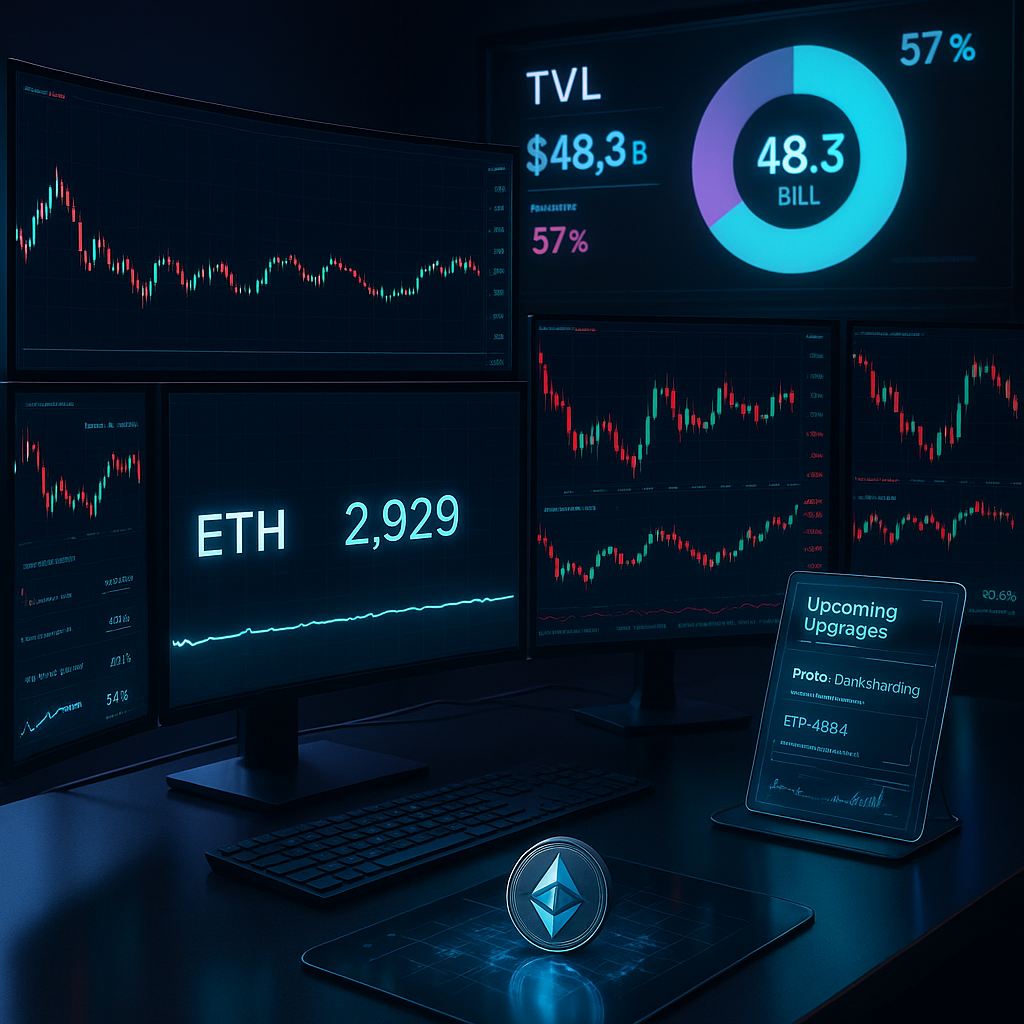
- Ethereum price stability persists: ETH remains near $2,929 despite significant fluctuations affecting other cryptocurrencies.
- Altcoins experience higher volatility: Competing tokens have seen sharper price swings, highlighting shifting trader sentiment.
- Institutional confidence in ETH grows: Consistent price action and strong TVL data indicate deeper trust in Ethereum’s long-term value.
- Ethereum leads in TVL among layer-1s: The platform holds the top position in total value locked, reinforcing its influence in decentralized finance.
- Attention turns to upcoming upgrades: Investors are monitoring how future Ethereum network updates could affect its ecosystem and market performance.
Introduction
Ethereum price stability continued at $2,929 on Monday, even as other altcoins faced notable fluctuations on major exchanges. This resilience distinguishes Ethereum from broader crypto volatility. It also signals increasing confidence in its strengths, with its Total Value Locked (TVL) surpassing other layer-1 networks. At the same time, investor focus is shifting toward the blockchain’s upcoming upgrades.
Ethereum’s Price Stability in Context
Over the past week, Ethereum has maintained a stable price point around $2,900, with daily fluctuations of less than 1%, despite significant market volatility elsewhere. In contrast, many altcoins have experienced price swings of 7 to 15% during the same period.
As the second-largest cryptocurrency by market capitalization, Ethereum has exhibited trading patterns that more closely resemble established financial assets than speculative cryptocurrencies. This trend follows the network’s completed transition to proof-of-stake consensus last year.
Ethereum’s trading volume has held steady at approximately $8.5 billion per day across major exchanges, reflecting balanced buying and selling activity. This balance suggests market participants are largely in agreement about Ethereum’s current valuation.
Stay Sharp. Stay Ahead.
Join our Telegram Group for exclusive content, real insights,
engage with us and other members and get access to
insider updates, early news and top insights.
 Join the Group
Analysts observe that this stability has emerged at a time when Bitcoin, the market leader, has shown daily price movements between 3% and 5%. This highlights the diverging behavior of Ethereum within the crypto landscape.
Understanding Total Value Locked (TVL)
Ethereum currently boasts $48.3 billion in Total Value Locked, representing assets committed to applications on its blockchain. In simple terms, TVL tracks how much cryptocurrency users have placed in Ethereum-based applications for lending, trading, or liquidity provision.
For newcomers, TVL is a valuable metric that offers greater insight into blockchain usage than price alone. While prices indicate trading activity, TVL reflects actual utility and adoption.
Ethereum accounts for more than 57% of the TVL across all blockchains, maintaining a commanding lead. The next closest competitor holds only $11.7 billion, illustrating a significant gap in real-world usage.
Institutional investors give substantial weight to TVL when evaluating blockchain investments. Mark Davidson, analyst at Blockchain Capital Research, stated that TVL serves as a key indicator, much like revenue or user growth in traditional sectors.
Fundamentals vs. Price Movements
Ethereum’s core network metrics have continued to improve despite fluctuations in price. Transaction counts have risen by 12% quarter-over-quarter, and active addresses have increased by 8.3% during the same timeframe.
These indicators point to growing adoption, independent of short-term market moves. For those new to cryptocurrency, recognizing the distinction between fundamentals and price trends is essential.
Developer activity within Ethereum remains strong, with over 4,000 monthly active developers contributing to the network. This figure surpasses that of all other blockchain platforms combined, underpinning the network’s technical strength.
Gas fees on Ethereum, which represent transaction costs, have decreased by 74% from their 2021 highs. This change is the result of scaling solutions that have improved usability for daily transactions. This further enhances the platform’s long-term appeal.
Comparison with Other Layer-1 Blockchains
Compared to other layer-1 blockchains, Ethereum demonstrates superior stability across multiple metrics. While competitors such as Solana, Avalanche, and Cardano have experienced volatility ranging from 12% to 18% in the past month, Ethereum’s price has remained within a narrower 5% band.
Ethereum’s transaction reliability has reached 99.98% uptime in the last year, in contrast to competitors that have faced periodic outages or congestion. This reliability is crucial for decentralized applications requiring consistent performance.
The Ethereum developer ecosystem is also substantially larger, boasting five times more monthly active developers than its nearest rival. This advantage results in more applications, accelerated innovation, and improved security.
Amelia Zhang, a blockchain researcher at Digital Asset Institute, noted that Ethereum’s stability derives from mature infrastructure and extensive testing. She added that newer platforms may promise advantages, but have not yet demonstrated the same real-world resilience.
Upcoming Network Upgrades
Ethereum’s development roadmap features several major upgrades in 2024 aimed at improving scalability and reducing costs. These enhancements target greater accessibility for users, regardless of technical experience.
The “Proto-Danksharding” upgrade, expected in the first half of 2024, aims to boost transaction throughput by approximately 100 times for certain types of activity. In practice, this will enable faster and more affordable transactions, particularly for NFT minting and token swaps.
Another key update, EIP-4844, is designed to lower data storage costs on the network. This change could reduce fees by up to 90% for applications relying on large amounts of stored information.
Stay Sharp. Stay Ahead.
Join our Telegram Group for exclusive content, real insights,
engage with us and other members and get access to
insider updates, early news and top insights.
Join the Group
According to explanations by the Ethereum Foundation, these upgrades are like expanding a highway and making vehicles more efficient at the same time. The intended result is faster and cheaper transactions for everyday users.
Conclusion
Ethereum’s steady price performance and robust underlying metrics differentiate it from more volatile altcoins. This reinforces its role as a foundational platform in the cryptocurrency sector. Ongoing improvements in scalability, cost efficiency, and high developer participation continue to support its adoption.
What to watch: Upgrades such as Proto-Danksharding and EIP-4844 are scheduled for rollout through 2024 and could significantly enhance user experience and reduce costs.


Leave a Reply