
Key Takeaways
- Cryptocurrency’s impact in emerging markets reaches far beyond speculation or media hype. For millions facing financial instability or exclusion, crypto provides critical access, security, and control, serving as a true financial lifeline. This article highlights stories from Nigeria, Argentina, and the Philippines, showing how everyday people leverage digital assets to gain monetary stability, inclusion, and autonomy even in turbulent economies.
- Crypto serves as protection against runaway inflation: In Argentina, citizens use stablecoins and bitcoin to protect their life savings from rapid peso devaluation. This enables practical, day-to-day hedging that empowers families to safeguard their purchasing power and moves beyond crypto as a mere investment vehicle.
- Overcoming financial red tape and restrictions: Nigerians turn to peer-to-peer (P2P) crypto trading to bypass strict currency regulations, facilitating smoother cross-border business and personal transactions. This allows individuals and businesses to operate outside the constraints of unreliable local banking infrastructure.
- Revolutionizing remittances with lower costs and instant transfers: Filipino families are now receiving money faster and losing less to transaction fees thanks to crypto platforms. This shift enables every peso earned abroad to support health, education, and basic needs more effectively.
- Bridging the gap for the unbanked and underbanked: Blockchain and crypto services offer accessible financial tools to millions excluded from traditional banking systems. In regions long underserved by established institutions, these innovations foster greater financial inclusion and economic participation.
- Necessity, not speculation, powers crypto adoption: The primary driver for digital asset adoption in emerging markets is the need for everyday stability, fiscal freedom, and community resilience, not the pursuit of quick profits.
- Regulation and innovation in careful balance: As grassroots crypto use grows, local governments are updating policies and frameworks. They aim to address risks while also meeting the undeniable demand for accessible, transparent financial alternatives.
- NFTs and new digital income streams: Beyond payments, NFT-powered platforms create new markets for earning, creation, and trade. Individuals in emerging economies can now build additional sources of income by monetizing digital assets, further diversifying their financial options.
These case studies reveal that crypto’s most profound impact is not just technological but deeply human. In the following sections, you’ll see how practical crypto adoption is fundamentally reshaping the financial stories of individuals and communities around the world.
Introduction
Imagine fighting inflation so intense that your monthly paycheck loses value before you can spend it. Or trying to send money across borders, only to lose nearly a day’s wages to fees, or being unable to pay for online business tools because of strict currency controls. For millions in countries like Argentina, Nigeria, and the Philippines, these are daily realities.
Far removed from the headlines of overnight millionaires and market speculation, the true story of crypto in emerging economies is one of practicality and empowerment. Stablecoins help families hedge against relentlessly depreciating currencies. Peer-to-peer crypto networks make everyday business possible by bypassing red tape. Blockchain remittances put more money in the hands of families depending on support from overseas.
In this article, we’ll explore how the urgent need for financial security, not speculation, is at the heart of crypto adoption in Nigeria, Argentina, and the Philippines. You’ll discover how crypto is rewriting financial futures and opening doors long closed by traditional systems, one transaction at a time.
Stay Sharp. Stay Ahead.
Join our Telegram Group for exclusive content, real insights,
engage with us and other members and get access to
insider updates, early news and top insights.
 Join the Group
Nigeria: Banking the Unbanked Through Blockchain
Nigeria’s journey with cryptocurrency demonstrates the real-world impact of digital assets as alternative financial tools. With almost 40% of Nigerian adults lacking access to formal banking, crypto has evolved from curiosity to a practical solution for millions.
Overcoming Traditional Banking Barriers
Nigeria’s banking landscape faces major obstacles. Most bank branches cluster in metropolitan areas, leaving rural parts of the country with limited services. Even urban residents face high minimum balances and transaction fees, excluding lower-income Nigerians from the system.
These constraints stifle economic participation for many. Emmanuel Babalola, a small business owner in Lagos, shared his experience. “Before crypto, getting paid by overseas clients meant agonizing delays and up to 15% lost in transaction fees,” he says. “Now, payments are instant and affordable.”
This is not an isolated example. Nigeria consistently ranks among the world’s leaders in P2P Bitcoin trading, according to Chainalysis, with activity mainly driven by daily necessity instead of speculation. Farmers, freelancers, and entrepreneurs are increasingly using crypto as a stable payment method.
Navigating Currency Controls and Instability
The Nigerian economy is shaped by government-imposed capital restrictions and frequent devaluations of the naira. Double-digit inflation has made it harder for everyday citizens to maintain their purchasing power.
Adebayo Juwon, a software developer from Ibadan, experienced this firsthand. When the Central Bank restricted foreign currency transactions, Juwon’s ability to pay for digital tools required for his work vanished. “Crypto, and Bitcoin in particular, became my only means of accessing global services and keeping my business afloat,” he recalls.
On a larger scale, businesses impacted by currency risk increasingly turn to stablecoins, such as USDT, to navigate the regulatory maze and mitigate losses. Through P2P trades, companies are building an informal parallel finance system that operates alongside the country’s established banks.
Community-Led Crypto Education
Much of Nigeria’s practical adoption has been fueled by bottom-up learning. In cities like Lagos, Abuja, and Port Harcourt, blockchain community hubs deliver free training on the basics, focusing on real-world crypto applications rather than trading alone.
Groups such as the Blockchain Nigeria User Group have trained thousands in secure crypto use for business, remittances, and savings. These programs prioritize hands-on education and digital safety, meeting the demand for practical knowledge in a country where financial literacy levels are often low.
In northern states, organizations like BlockchainNG reach out to small-scale agricultural producers. They teach farmers how to use crypto for payments and access new markets, replacing barriers of traditional cross-border banking with simple mobile transactions. This outreach brings the benefits of digital assets to communities historically left outside mainstream finance.
As Nigeria’s regulatory climate for crypto continues to develop, these grassroots education efforts ensure that more people can confidently use the technology to access opportunity. It’s a testament to crypto as a tool for inclusion over speculation.
Expanding beyond the financial sector, Nigerian creatives and tech startups are tapping into blockchain solutions for everything from art authentication to transparent crowdfunding. The impact of crypto in Nigeria extends across economic sectors.
Argentina: Battling Hyperinflation with Digital Assets
In Argentina, cryptocurrency is not a luxury. It’s a survival strategy in an economy stricken by runaway inflation, capital restrictions, and a volatile currency.
Stablecoins Offer Daily Protection
For the average Argentinian, holding cash in pesos means watching your savings shrink month after month. With inflation often exceeding 100% annually, stability is almost impossible without alternative solutions.
Many citizens, like María Fernández, a teacher in Buenos Aires, have adopted a routine of converting their salaries to USDC stablecoins as soon as payday arrives. “It’s the only way I can preserve purchasing power until I need to spend the money,” she says. This is now a common approach among Argentina’s middle class, who are often unable to access sufficient quantities of U.S. dollars through official channels.
Unlike more speculative crypto markets, Argentina’s stablecoin usage is grounded in day-to-day necessity. For many, USDT and USDC function as digital savings accounts, bringing resilience to household finances battered by continuous currency depreciation.
Stay Sharp. Stay Ahead.
Join our Telegram Group for exclusive content, real insights,
engage with us and other members and get access to
insider updates, early news and top insights.
Join the Group
Local crypto exchanges such as Lemon Cash and Buenbit play a pivotal role. Through user-friendly apps, they let users store digital dollars, spend via debit cards, and manage bills, all while avoiding the worst effects of inflation.
Crypto-Fueled Parallel Economies
As digital assets become more integrated, an alternative economy is quietly thriving. In tourist hotspots like Buenos Aires’s Palermo district, businesses such as Carlos Mendoza’s café accept Bitcoin and Ethereum from international patrons, converting a portion to pesos for operations and holding the rest as a hedge.
Argentine freelancers and tech workers are also negotiating salaries in crypto (particularly USDC or bitcoin) when working with overseas employers. This enables them to sidestep the “blue dollar” (unofficial exchange) rate, effectively earning up to 70% more than those relying on traditional banking channels. Diego Peralta, a software developer, shares, “Receiving pay in USDC means real value for work done, not the shrinking returns of the formal financial system.”
This digital parallel economy not only diversifies income but fosters financial sovereignty. Even sectors like agriculture are experimenting with blockchain for crop exports and fairer pricing, broadening the impact of crypto beyond urban tech hubs.
Government Adaptation and Response
The official Argentine stance on cryptocurrency is evolving. While regulatory efforts have ranged from proposed taxes to tentative state-backed currencies, enforcement remains limited and inconsistent. Most Argentinians see this regulatory ambiguity as yet another hurdle, one that digital assets are uniquely equipped to overcome.
Faced with unreliable monetary policy, residents turn to blockchain as a shield against uncertainty. The rapid, organic adoption of crypto is less about government endorsement and more about people seizing whatever tools are available for financial control.
In addition to finance, Argentine artists and content creators are finding new revenue through NFT marketplaces, claiming royalties on digital work that are immune to local currency fluctuations.
Philippines: Revolutionizing Remittances Through Digital Currencies
The Philippines showcases how targeted crypto solutions can address specific national economic needs, in this case making remittances more affordable, reliable, and accessible.
Making Remittances Faster and More Affordable
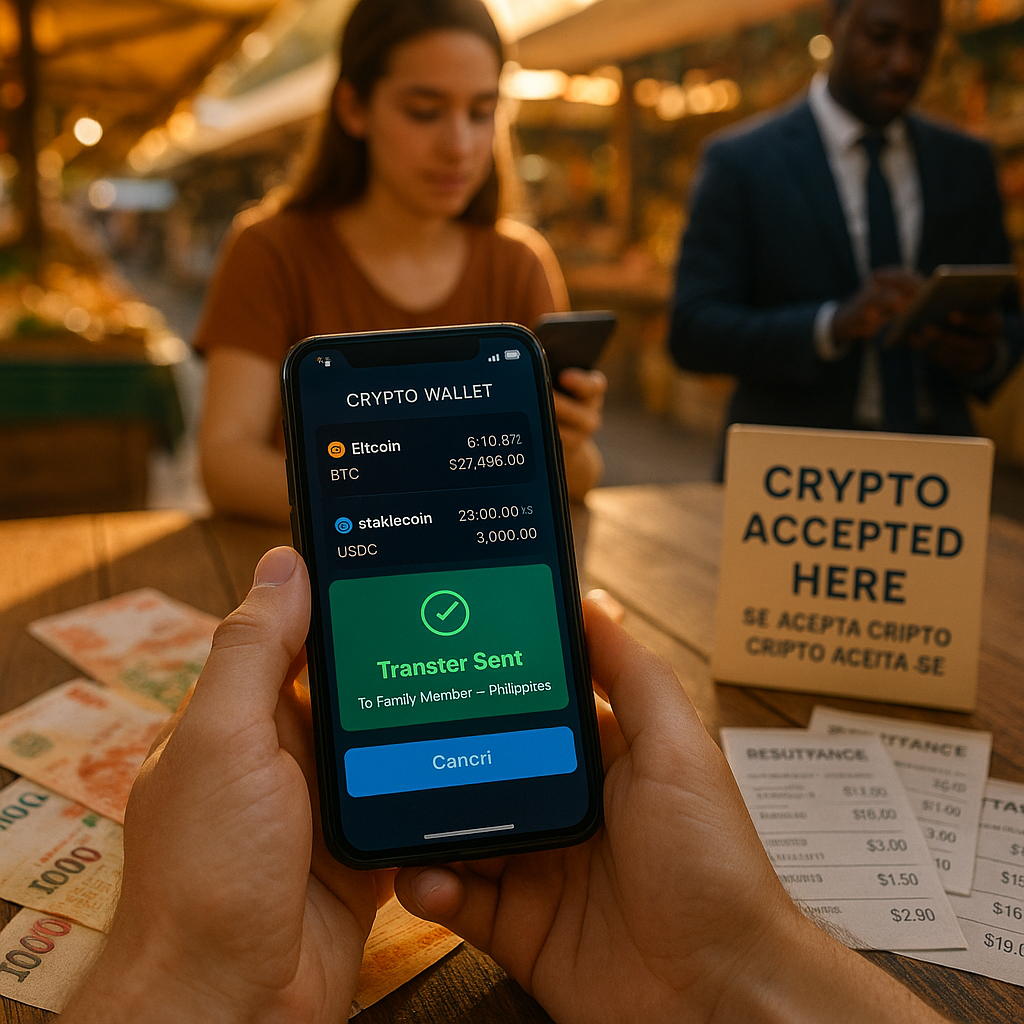
With over 10 million Filipinos working abroad, family remittances back home are a multi-billion dollar lifeline, yet traditional methods eat away at their value. Companies like Western Union and MoneyGram routinely charge 5-7% in fees, while transfers can take days.
Ana Santos, a domestic worker in Hong Kong, recounts her transformation. “Sending money to Cebu used to cost me a day’s wages in fees each month. Since switching to a local crypto exchange that supports XRP, almost everything I send ends up in my family’s hands, and it’s instant.”
The difference is striking. A nurse in Dubai who sends $500 home could lose $25-35 to legacy fees, with waits of up to 72 hours. Crypto platforms reduce fees to a few dollars and transfer times to mere minutes. This efficiency directly enhances household budgets, allowing families to redirect savings to health, education, or investment.
Given that remittances represent nearly 10% of the Philippines’ GDP (over $33 billion annually), even modest adoption of crypto-powered transfers translates to billions in savings and higher local consumption.
Seamlessly Integrating Crypto and Local Finance
Part of the Philippines’ success with crypto comes from smooth connections between digital assets and traditional cash networks. Services like Coins.ph enable users to swap crypto for pesos and cash out at neighborhood stores, pawnshops, and rural banks, reaching communities far from mainstream financial hubs.
This integration is bolstered by proactive regulation. The Bangko Sentral ng Pilipinas was among the world’s first central banks to license and oversee virtual currency exchanges. Clear rules encourage both innovative startups and established lenders to collaborate, delivering user-friendly products that inspire trust.
For the Reyes family in Batangas, this connectivity means they can receive funds from a relative in Canada almost instantly. They simply visit a local convenience store to convert the digital funds to pesos for groceries or tuition, skipping long bank queues and excessive delays.
Beyond remittances, Filipino freelancers are capitalizing on global gig platforms that pay in crypto, diversifying income sources regardless of local economic uncertainty. NFT marketplaces have also caught on, letting artists and game developers participate directly in the emerging digital economy.
By combining inclusive technology with practical regulation, the Philippines demonstrates how crypto can power financial inclusion in both urban and rural settings.
Expanding the Lens: Crypto’s Broader Impact Across Industries and Regions
While this article highlights the transformative role of crypto in Nigeria, Argentina, and the Philippines, similar patterns are emerging elsewhere and across diverse sectors. In Vietnam, entrepreneurs use blockchain to manage supply chains in agriculture, offering increased transparency for farmers and exporters. In Kenya, decentralized finance (DeFi) platforms are allowing small businesses to access microloans that traditional banks won’t provide, fostering local growth and entrepreneurial resilience.
Healthcare providers in India are piloting blockchain for secure health record management, improving patient access even in underbanked areas. Meanwhile, in Eastern Europe, educators leverage tokenized rewards to boost student engagement, illustrating how digital assets extend beyond finance into social impact.
These real-world examples reinforce a consistent takeaway: wherever financial exclusion or inefficiency exists, practical crypto solutions are empowering individuals and industries to unlock new opportunities.
Conclusion
Across Nigeria, Argentina, and the Philippines, cryptocurrency stands out not as a speculative fad, but as a vital and adaptable financial tool addressing core challenges of access, inflation, and cross-border payments. In Nigeria, blockchain is breaking down decades-old barriers, letting entrepreneurs and rural communities transact, save, and grow on their own terms. Amid Argentina’s hyperinflation, stablecoins have gone from niche assets to household stabilizers, giving everyday people the ability to shield their hard-earned money. Filipino families, through crypto-powered remittances, are keeping more of each overseas dollar, turning financial lifelines into ladders for progress.
These case studies are united by necessity and ingenuity, not hype. They demonstrate the power of communities to adapt and prosper when equipped with the right technology. As the world’s financial systems evolve, the lessons of these emerging markets carry global resonance: technology, when tuned to real needs, can drive meaningful financial inclusion at unprecedented scale.
Looking ahead, those who build foundational knowledge and remain open to responsible crypto adoption will be best positioned to seize tomorrow’s opportunities. Whether you are new to crypto or exploring new ways to earn and engage, the path starts with learning the principles and practicalities of Web3. In an increasingly digital global economy, the real competitive edge will go to those who can navigate change, leverage innovation wisely, and use these new tools not simply to speculate, but to shape their own financial future.
Learn. Earn. Repeat.




Leave a Reply