
Key Takeaways
- Put your NFTs to work with lending platforms: NFT lending platforms enable you to use your NFTs as collateral to borrow crypto, giving holders liquidity without the need to sell prized assets.
- Unlock shared ownership through fractionalization: NFT fractionalization allows high-value or iconic NFTs to be divided into affordable shares, making blue-chip assets accessible to broader audiences and enabling collective investment.
- Boost NFT earning potential by renting out your assets: Renting NFTs allows owners to generate passive income while renters gain access to high-value assets for gaming, virtual experiences, or events without the burden of an upfront purchase.
- NFTs become DeFi collateral for smarter borrowing: By integrating NFT collateral into DeFi protocols, users can leverage unique assets to access loans or participate in innovative financial tools, forging a direct link between digital art and the broader crypto financial ecosystem.
- Navigate new risks as NFTs become financial instruments: As NFTs move beyond digital art into the finance realm, users must understand smart contract risks, asset volatility, and illiquidity, making security and due diligence essential practices.
- Democratize the metaverse through broader NFT access: Fractionalization and renting reduce barriers to entry, giving more people the opportunity to participate, invest, and interact in NFT-powered ecosystems, regardless of their budget.
NFTfi does more than open doors to earning and liquidity. It reshapes the very concept of digital ownership and value in Web3. In the following sections, we break down each mechanism, provide real-world examples across industries, and guide you step by step through both the risks and rewards.
Introduction
NFTs are evolving far beyond digital collectibles to become robust financial tools that unlock practical benefits for both seasoned holders and curious newcomers. At the core of this revolution is NFTfi (a sector that empowers anyone to borrow crypto using NFT collateral), invest in renowned assets via fractionalization, or earn by renting out digital property, all while retaining ownership and autonomy.
Understanding these NFT financialization strategies puts you in the driver’s seat of Web3’s ongoing transformation. With NFT lending platforms, fractionalization, and renting, you gain new ways to participate in the decentralized economy, opening up pathways for passive income, shared investment, and wider accessibility.
What is NFTfi?
NFTfi is the rapidly emerging intersection of Non-Fungible Tokens (NFTs) with Decentralized Finance (DeFi), expanding the role of digital assets from static collectibles to dynamic financial instruments. This new paradigm allows NFT owners to derive tangible value from their assets well beyond the traditional cycle of buying and selling.
Stay Sharp. Stay Ahead.
Join our Telegram Group for exclusive content, real insights,
engage with us and other members and get access to
insider updates, early news and top insights.
 Join the Group
By incorporating mechanisms like NFT-backed loans, splitting ownership via fractionalization, and renting or leasing out utility, NFTfi transforms often illiquid NFTs into productive, versatile tools. The result is a solution to one of the NFT market’s main challenges: liquidity. Historically, NFT owners had to choose between holding onto digital assets for the long term or selling them outright. Now, they can tap into their value without giving up ownership or potential upside.
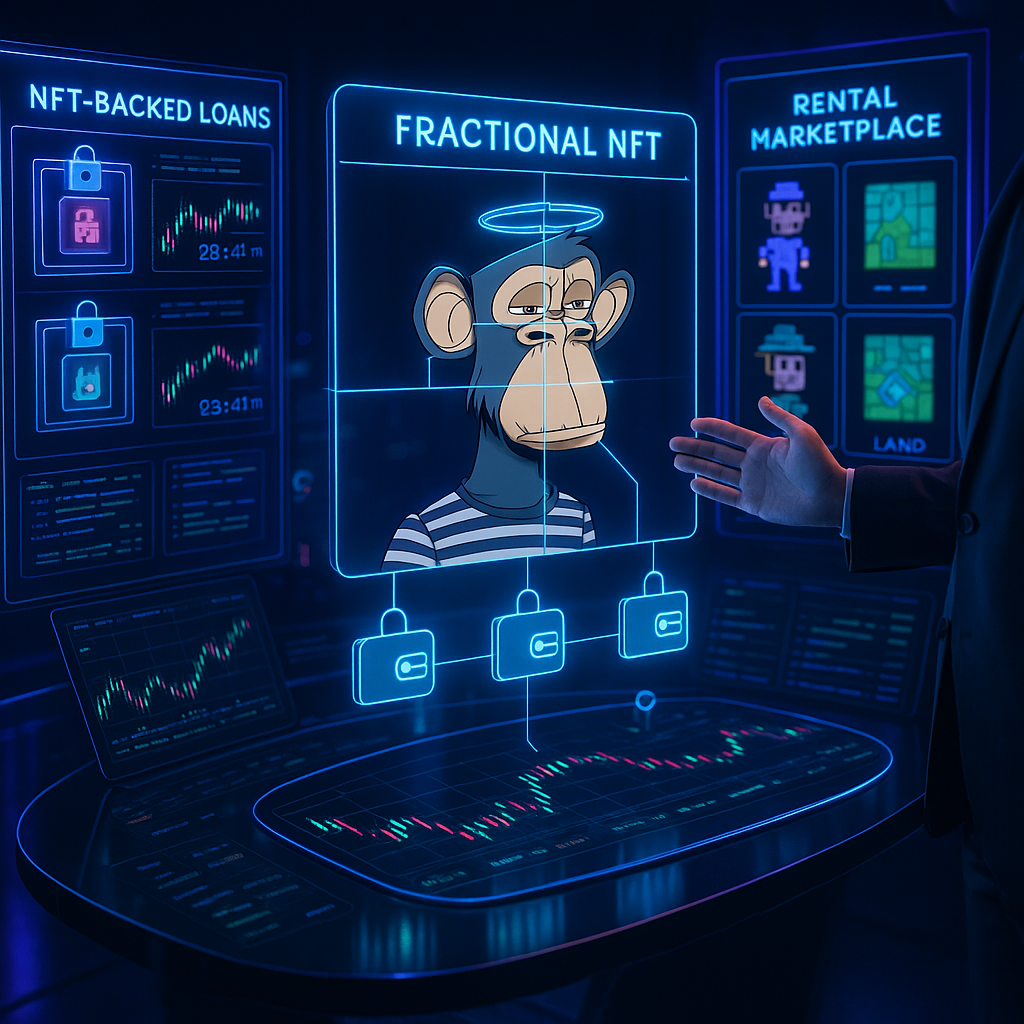
Imagine a collector who owns a Bored Ape Yacht Club NFT valued at 80 ETH. Whether their goal is immediate liquidity, shared investment, or passive income, they can:
- Take out a 40 ETH loan using the NFT as collateral
- Fractionalize the NFT, retaining a portion while selling shares to others
- Rent the NFT to brands or metaverse projects for short-term fees
These options represent a shift in how digital assets can function, enabling more strategic use and unlocking real-world utility. The NFTfi space is now home to sophisticated protocols and multi-industry applications, but with opportunity comes a new set of risks and responsibilities. Next, we explore how NFT lending brings liquidity to digital ownership and examine its practical applications across various sectors.
NFT Lending and Borrowing
NFT lending platforms create a new frontier for financial empowerment, allowing owners to use digital assets as collateral and tap into liquidity without relinquishing their prized collectibles. This approach benefits NFT holders seeking capital and lenders looking for returns on their assets. It echoes similar trends in traditional finance but is tailored to an evolving digital asset class.
How NFT Loans Work
The loan process on most NFT lending platforms unfolds in a series of secure, transparent steps:
- Collateral Deposit: The borrower transfers the NFT into a secure smart contract.
- Loan Terms Agreement: Both parties agree on the loan amount, interest rate, and loan duration.
- Loan Funding: The lender supplies the agreed-upon cryptocurrency to the borrower.
- Repayment or Default: The borrower either repays the loan plus interest to reclaim the NFT or defaults, allowing the lender to take permanent possession of the NFT.
Most platforms offer peer-to-peer marketplaces where borrowers and lenders connect directly, although some utilize pooled liquidity. This is a model borrowed from DeFi lending protocols in finance and real estate, which aggregates funds from multiple sources for broader flexibility.
Types of NFT Loans
NFT lending platforms generally offer two primary loan models:
- Fixed-term loans:
- Set timeframe with a predetermined interest rate and clear repayment schedule.
- Lower interest rates.
- Predictability for both parties.
- Example: A 30-day, 10% APR loan with full repayment at term’s end.
- Perpetual loans:
- No strict end date; interest accrues continuously.
- Higher interest rates.
- Borrower can repay at any point to retrieve their NFT.
- If the NFT’s value drops below a specified threshold relative to the loan, the lender may seize the asset.
This flexibility has inspired innovative applications not just in art and collectibles, but also in other fields. For instance, in gaming, players can leverage rare in-game items as collateral. Similarly, music industry participants use NFT-backed loans to finance creative projects without selling rights.
Leading NFT Lending Platforms
Several notable platforms have emerged to bridge NFTs and DeFi lending:
- NFTfi: A pioneer in peer-to-peer NFT-backed loans, supporting a diverse range of collectibles and digital assets.
- BendDAO: Specializes in pooled liquidity, delivering instant loans on top-tier NFT collections.
- Arcade: Targeted high-value loans for premium NFTs, but its website currently shows only a “Coming soon” page.
- MetaStreet: Focuses on large-scale, securitized NFT lending, offering risk tranches.
These platforms are expanding rapidly, influencing sectors beyond art. For example, in healthcare research, tokenized access to proprietary data sets or scientific works can be collateralized. This enables institutions to unlock funding without losing IP ownership.
Risks in NFT Lending
Despite the potential for liquidity and earnings, NFT lending still involves important risks:
- Liquidation risk: Borrowers lose permanent access to their NFT if the loan goes unpaid.
- Market volatility: Rapid changes in NFT and crypto prices can put loan agreements at risk.
- Asset devaluation: Entire NFT collections may lose cultural relevance or market value suddenly.
- Smart contract vulnerabilities: Technical flaws may expose assets to theft or malfunction.
- Counterparty risk: In peer-to-peer settings, borrowers and lenders must trust the platform and each other (although smart contracts provide some mitigation).
Best practice: Borrow well below your NFT’s verified floor price to safeguard against sudden downturns or price fluctuations.
NFT lending is just one way to unleash liquidity. Next, NFT fractionalization multiplies possibilities for shared investment, industry-wide collaboration, and mass participation. This enables more users to access and benefit from digital asset ownership.
NFT Fractionalization
NFT fractionalization introduces true accessibility, allowing multiple individuals to own fractional shares of a single NFT (whether it’s a digital masterpiece, a piece of intellectual property, or even a metaverse parcel). This mechanism is enabling the democratization of high-value assets, stimulating market liquidity, and broadening the appeal of NFTs beyond dedicated collectors.
How Fractionalization Works
Fractionalization involves several key steps, all governed by transparent smart contracts:
- NFT Locking: The original NFT is deposited into a smart contract-secured vault.
- Token Issuance: The system mints a chosen number of fungible ERC-20 tokens, each representing a pro-rata share of the NFT.
- Distribution/Sale: The fractional tokens are distributed to the original owner, sold publicly, or reserved for community initiatives.
- Governance Implementation: Rules are established for collective decision-making (such as voting to sell the original NFT if a buyout offer arises).
For example, a Cryptopunk valued at 100 ETH could be split into 1,000 tokens, each theoretically representing 0.1 ETH of ownership. That makes investment far more practical for individuals and small groups.
Stay Sharp. Stay Ahead.
Join our Telegram Group for exclusive content, real insights,
engage with us and other members and get access to
insider updates, early news and top insights.
Join the Group
Benefits of Fractionalization
Fractionalization delivers transformative benefits:
- Democratized ownership: Anyone can own a portion of world-famous NFTs, regardless of initial capital.
- Enhanced liquidity: Partial ownership tokens can be traded on exchanges, vastly improving asset mobility.
- Price discovery: Open market trading of fractional tokens helps establish more accurate, transparent NFT valuations.
- Community formation: Groups can form around shared digital ownership, opening doors to DAOs, metaverse guilds, and shared governance.
- Diversification: Investors with modest budgets can hold shares in several high-value NFTs, reducing risk.
This model goes well beyond art. In real estate, projects use “NFT deeds” to fractionalize property shares. In the sports industry, fans collectively invest in unique memorabilia or highlight reels via fractional tokens.
Leading Fractionalization Platforms
- Tessera (formerly Fractional.art): Focused on high-value digital and cultural assets, but its platforms are no longer in operation.
- NFTX: Creates liquid indexes of NFT collections, such as Punks, for collective investment.
- PartyBid: Enabled groups to pool resources for collective NFT purchasing, then split ownership among backers; PartyDAO’s later app, Party, has been deprecated and is no longer accessible after March 9, 2026.
Each platform brings unique governance tools and buyout rules, so due diligence is key.
Unique Applications Across Industries
Fractionalization has sparked many novel use cases, including:
- NFT indexes: Bundling high-value NFTs into tradable baskets, similar to stock indexes.
- NFT DAOs: Communities pooling resources to acquire, manage, and even license NFTs and intellectual property.
- Cultural preservation: Museums and historical institutions fractionalize digital artifacts, letting the public collectively own and vote on their future.
- Healthcare and research: Consortiums of medical institutions tokenize rights to rare genomic data or clinical studies, enabling broad but secure participation and funding.
- Legal and copyright: Fractionalizing royalty and licensing rights to songs, academic papers, or patents offers new ways to finance and share value.
Risks and Challenges
Fractionalization brings fresh challenges:
- Regulatory ambiguity: Some fractional tokens may be classified as securities, resulting in complex compliance requirements.
- Thin liquidity: Lower trading volumes for certain tokens can create price swings and illiquidity.
- Smart contract risk: Underlying coding errors can compromise the NFT or its governance.
- Buyout disputes: Deciding when to sell the full NFT may require clear and fair governance rules.
- Potential value dilution: Widespread fractionalization could challenge the premium associated with exclusive, sole ownership.
As with all DeFi and NFT innovations, research and caution remain essential. For those seeking recurring yield and flexible access, NFT renting provides another layer of utility. That’s a trend growing rapidly across gaming, media, marketing, and education.
NFT Renting and Leasing
NFT renting introduces an adaptable way to create utility and generate income from digital assets, without transferring ownership. Owners benefit from passive earnings, while renters gain temporary access to in-demand assets for a specific need or timeframe.
How NFT Renting Works
The NFT rental cycle operates through purpose-built platforms that automate trust and transfer of rights:
- Listing Creation: The owner specifies the rental terms: duration, price, and available functionality.
- Collateral Handling: Depending on the platform, renters may be required to provide collateral.
- Smart Contract Deployment: A self-executing agreement encodes the terms, ensuring transparency and security.
- Usage Rights Transfer: The renter gains access or control (e.g., in-game benefits, event passes, or digital displays) for the agreed period, without ever gaining true ownership.
- Expiration and Return: When the term is up, rights automatically revert to the owner.
Different platforms support a diverse array of asset types and applications, from gaming skins and avatars to music streaming passes, business software licenses, or virtual conference tickets. The trustless nature of smart contracts aligns incentives and mitigates fraud risk.
Rental Use Cases and Benefits
Owners and renters both realize significant advantages:
- Owners: Earn passive income without parting with their asset.
- Renters: Access otherwise costly or exclusive NFTs for a short period; useful for gaming tournaments, metaverse event entry, brand campaigns, or business pilots.
- Flexible utility: Enterprises and individuals adapt NFT assets for short-term marketing, education, data analytics, or even healthcare (such as temporary access to software tools).
- Enhanced liquidity: Broadens utility and paves the way for secondary rental markets.
This model has seen success beyond digital art and gaming. For example, in education, students rent NFT-based curriculum or tools for specific coursework. In marketing, brands temporarily leverage rare NFTs for creative campaigns and online events. In retail, access to premium digital product drops may be rented for limited-time experiences.
An Example: reNFT
- reNFT: a protocol for collateral-free rentals of ERC-721 and ERC-1155 tokens, built on Gnosis Safe and Seaport. Its public code on GitHub was last updated in September 2024, and its website did not load when we checked in October 2026, so confirm the service is still running before you rely on it.
Platforms are rapidly diversifying their tools, fostering adoption in fields like education, data analytics, ad-tech, and event management.
Renting Risks and Limitations
Renting brings new considerations for both sides of the agreement:
- Smart contract risks: Vulnerabilities in code can result in asset loss or misuse.
- Platform risk: Stability and reputation of the rental service are critical for trust and continuity.
- Valuation challenges: Short-term value may be highly variable depending on demand or event timing.
- Limited regulation: Disputes can be harder to resolve without established legal precedents.
To address these challenges, emerging platforms are introducing insurance products, user verification, and reputation systems.
Conclusion
NFTfi is revolutionizing digital ownership, empowering users to move beyond collecting and into active, value-driven participation in the Web3 economy. By facilitating lending, fractionalization, and renting, NFTfi transforms illiquid collectibles into capital resources, collaborative investments, and sources of passive income. This innovation doesn’t just benefit art collectors. It extends market access to industries such as gaming, education, healthcare, retail, and finance, fueling creativity in both individual and institutional contexts.
Yet, as NFTs evolve into financial instruments, new risks inevitably arise: market volatility, technical vulnerabilities, regulatory headwinds, and evolving security threats. Navigating NFTfi successfully calls for a mindset rooted in education, research, and strategic thinking. Anyone stepping into this field should evaluate every protocol with diligence, keep informed on regulatory changes, and approach investments with an eye toward long-term empowerment rather than speculative hype.
Looking to the future, the convergence of NFTs and DeFi promises to reshape how we define value, ownership, and participation across the digital economy. Those who embrace continuous learning, adapt to technological advances, and use these tools thoughtfully will not just keep pace with change. They will help shape it. In this new era, informed ownership isn’t just a protective shield. It is the key to unlocking the vast economic opportunities of decentralized finance. The challenge ahead isn’t just to join the NFTfi movement, but to lead it with competence, curiosity, and confidence.



Leave a Reply